From Futuristic to Standard: Silicon Carbide

There was a time when silicon carbide in EV charging sounded like something reserved for the future. Seven years ago, it was still considered an advanced, almost experimental semiconductor technology, discussed mainly in the context of aerospace, high-performance electronics, and next-generation mobility. In DC charging infrastructure, it was far from the market norm.
At WILLBERT, we chose to implement silicon carbide power modules when it was still seen as bold engineering rather than an industry requirement. We believed that efficiency would become one of the most decisive factors in charging infrastructure economics.
What Silicon Carbide Actually Does
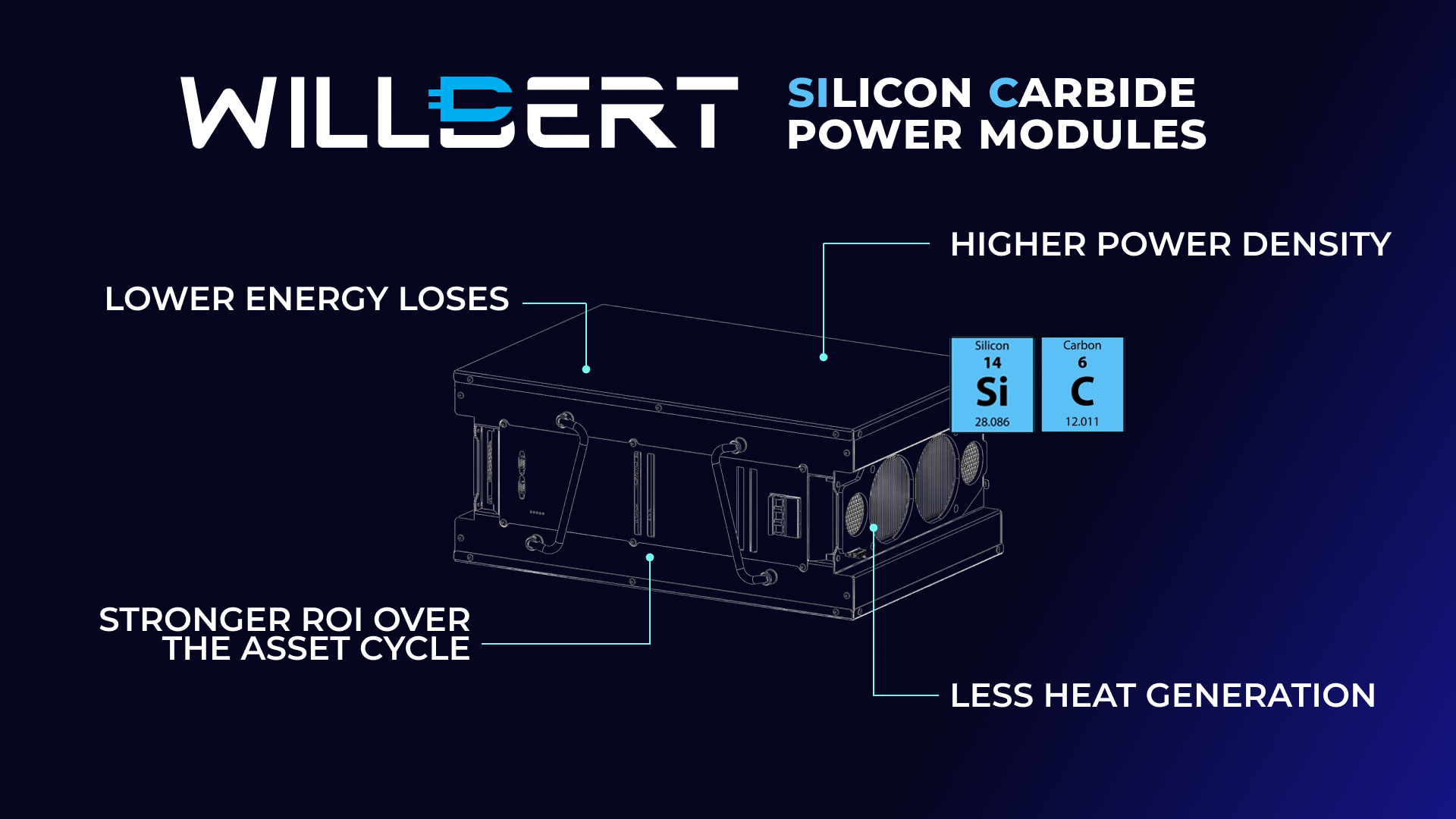
Silicon carbide significantly reduces energy losses while switching in power electronics. Compared to traditional silicon-based components, it enables higher efficiency, lower heat generation, and improved power density. Higher efficiency means more usable power delivered to the vehicle and less energy lost as heat. It means lower cooling requirements and reduced wear on components. Ultimately, it means stronger ROI over the lifecycle of the asset.

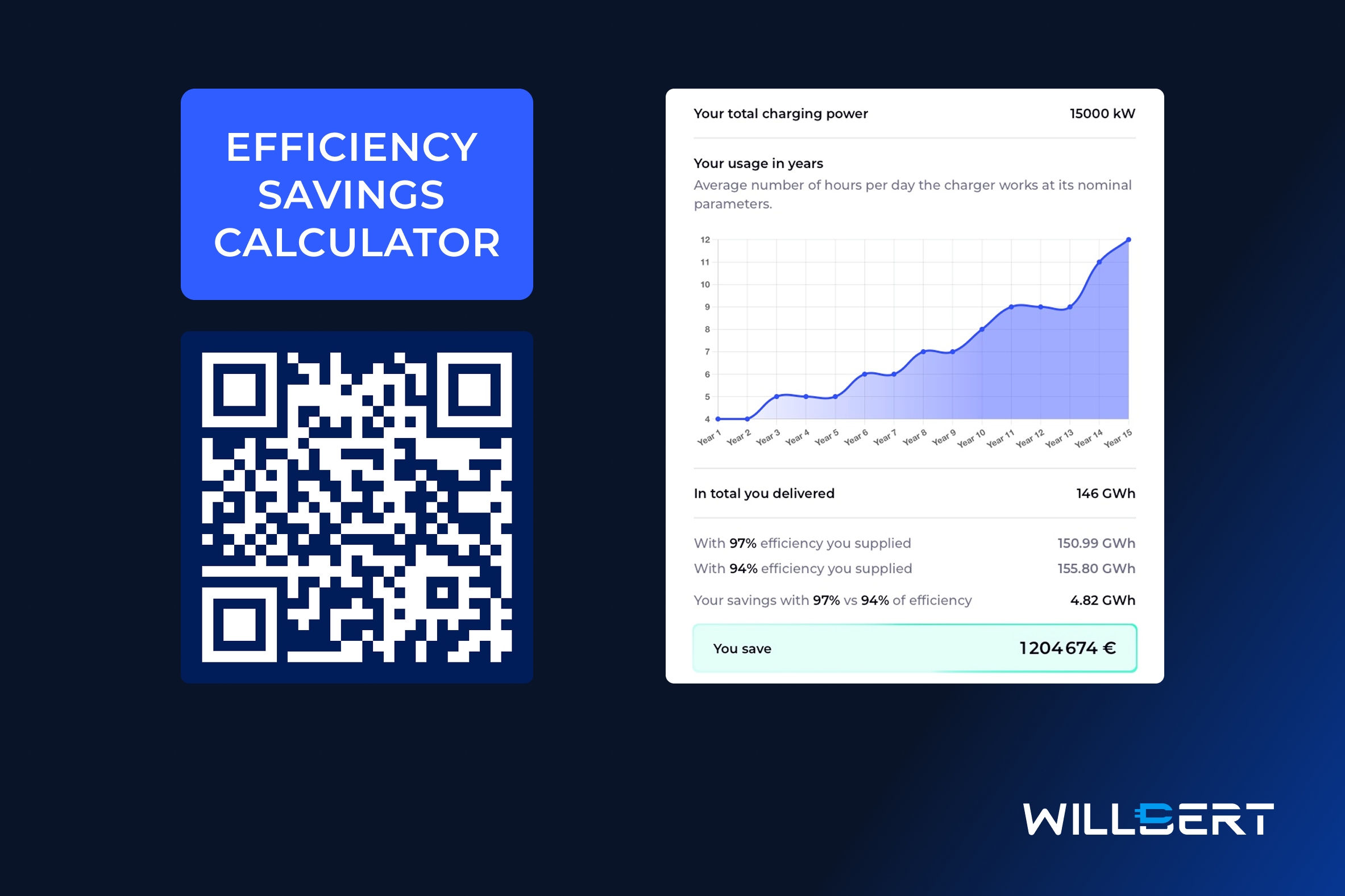
Across thousands of charging sessions, these savings compound meaningfully. Consider an operator running a network of 50 WILLBERT Amber II units, each rated at 300 kW. At that scale, the 4-percentage-point efficiency advantage (97% versus the 93% typical of silicon-based alternatives) translates directly into measurable financial performance. A 300 kW charger operating at 97% efficiency delivers significantly more usable energy per session than one losing 7% to heat and switching losses. Across a 50-unit network, that difference compounds over time: more energy delivered per kilowatt drawn from the grid, lower thermal stress on components, and reduced cooling overhead. Over the asset lifespan, operators in this scenario stand to avoid over €1,2 M in energy costs, without any change to pricing, throughput, or service operations. At 300 kW per unit, every percentage point of efficiency carries greater absolute weight. The financial case for silicon carbide is not theoretical. It is built into every session, across every unit, from day one.

Our Efficiency Savings Calculator, availbale at WILLBERT website, clearly demonstrates how efficiency impacts operational expenditure over time and how high efficiency architecture improves the financial performance of a charging site or the entire network. After setting requirements calculations are visualized on a graph.
From Innovation to Market Standard
High efficiency thresholds are now routinely written into procurement requirements. Silicon carbide has moved from differentiator to baseline expectation. Buyers no longer ask whether a charger is efficient. They set minimum thresholds and shortlist accordingly.
The distinction has shifted. It is no longer about who uses silicon carbide, but who has mastered it. Component selection is one step. Years of in-house manufacturing, real-world performance data, and iterative engineering refinement are another.
WILLBERT was the first company to introduce silicon carbide into DC charging hardware commercially. Since then, we have designed, manufactured, and continuously optimized our power modules in-house. That accumulated experience in thermal management, switching behavior, and long-term reliability cannot be replicated by integrating an off-the-shelf module. Efficiency is a design decision made at the component level, long before the product ever reaches a charging site.
This optimization extends beyond the module itself to the system architecture. The Amber II S-HUB is designed around a shared power platform: one charging system, two charging units, serving up to eight electric vehicles simultaneously. Rather than dedicating fixed power to each outlet, S-HUB distributes available capacity dynamically, routing more power to vehicles that can accept it, and less to those that are nearly full or charge at lower rates. The result is higher utilization of every kilowatt drawn from the grid, fewer idle power reserves, and a lower effective cost per kWh delivered across the site. Hardware-level efficiency, in other words, is not only about what happens inside the power module. It is also about how that power is allocated across the entire charging infrastructure.
Forward Thinking Then and Now
Looking back, silicon carbide was our forward-thinking moment in hardware. We identified the direction of the market before it became mainstream and built our chargers accordingly. Many companies have since followed the same path.
Today, WILLBERT's forward thinking extends beyond hardware into the software layer that runs on top of it. With silicon carbide efficiency and flexible power allocation as the foundation, the HAWKe platform transforms a high-performance DC charger into a connected, commercially intelligent EV charging hub.
The platform (HAWKe) integrates charge session management, payment processing (PayBERT), targeted in-session advertising (AdBERT), cross sell integrations (BuyBERT) and real-time technical monitoring into a single operator-facing platform. For Charge Point Operators managing multi-site networks, this means unified visibility, dynamic pricing capabilities, and data-driven insights, all built on hardware that minimizes energy waste from the first kilowatt delivered.
The next stage of EV charging is shaped by how efficiently energy is converted, how intelligently charging sessions are managed, and how effectively each interaction generates revenue beyond the energy itself. WILLBERT is engineered to address all three, from the semiconductor inside, through optimal hardware to the software platform that surrounds it.
Strong hardware enabled us to build reliable, high-efficiency DC charging solutions that remain future-ready. Now, with that technological groundwork in place, we are shaping the software-driven future of charging, where efficiency, user experience, and commercial intelligence work together.
Tomasz Rydz supports the execution of marketing strategy by creating audiovisual content and managing event presence at WILLBERT by EUROLOOP. He has a strong background in automotive marketing, he previously worked at Toyota Central Europe and a renowned tuning company in Florida. At EUROLOOP, he focuses on brand visibility, content creation, and engaging customer experiences in the evolving EV charging market.